




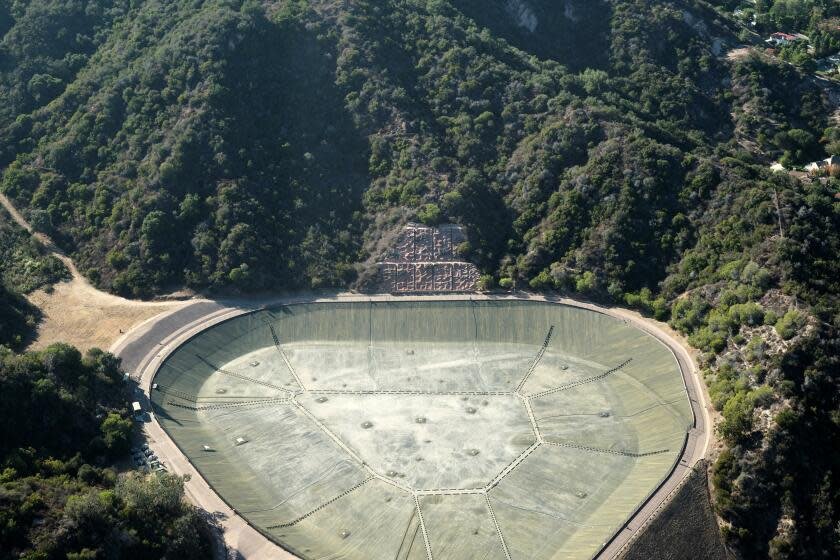
A large reservoir in Pacific Palisades that is part of the Los Angeles water supply system was out of commission when a ferocious wildfire destroyed thousands of homes and other structures nearby, the Los Angeles, Times reports.
Officials said that the Santa Ynez Reservoir had been closed since about February for repairs to its cover, leaving a 117-million-gallon water storage complex empty in the heart of the Palisades for nearly a year.
The revelation comes amid growing questions about why firefighters ran out of water while battling the blaze, which ignited Tuesday during catastrophically high winds. The Times reported early Wednesday that numerous fire hydrants in higher-elevation streets of the Palisades went dry, leaving crews struggling with low water pressure as they combated the flames.

On Friday, January 10, 2025, Gov. Gavin Newsom ordered an independent investigation of the Los Angeles Department of Water and Power over the loss of water pressure and the empty Santa Ynez Reservoir, calling it “deeply troubling.”
“We need answers to how that happened,” Newsom said in a letter to leaders of DWP and L.A. County Public Works.
DWP spokesperson Ellen Cheng said, “We appreciate the Governor’s letter and believe that an investigation will help identify any new needed capabilities for water systems to support fighting wildfires.”
DWP officials have said that demand for water during an unprecedented fire made it impossible to maintain any pressure on hydrants at high elevations.
Had the reservoir been operable, water pressure in the Palisades would have lasted longer on Tuesday night, said former DWP general manager Martin Adams, an expert on the city’s water system. But only for a time.
“You still would have ended up with serious drops in pressure,” Adams said in an interview Thursday. “Would Santa Ynez [Reservoir] have helped? Yes, to some extent. Would it have saved the day? I don’t think so.”
A DWP official acknowledged that the reservoir’s absence likely contributed to some diminished pressure and dry hydrants in upper regions of the Palisades.
However, a spokesperson for the utility said in a statement that DWP was still evaluating the effect of the reservoir being placed offline, and that staffers were conducting a root-cause analysis.
“Our primary focus is to provide water supply throughout the city,” the DWP spokesperson said, adding, “The system was never designed for a wildfire scenario that we are experiencing.”
Emptying of the reservoir began in February after a tear in the floating cover measuring several feet allowed debris, bird droppings and other objects to enter the water supply. DWP drained the site to avoid contamination and comply with water regulations.
DWP sought bids for the repair in April, at a cost of up to $89,000. In November, the utility signed off on a contract with a Lakeside firm for about $130,000, records show.
The status of the repairs is unclear. The DWP’s employee union leader condemned the months-long wait to restore the reservoir.
“It’s completely unacceptable that this reservoir was empty for almost a year for minor repairs,” Gus Corona, business manager of IBEW Local 18, said in an interview with The Times.
“This work should have been done in-house, and they shouldn’t have depended on a contractor to do it,” he said. “I truly believe it’s something that could have been avoided.”
Joseph Ramallo, a chief communications officer for DWP, said the reservoir was scheduled to reopen in February.
Whether the reservoir would have had a meaningful effect on fighting a blaze of such intensity, researchers said urban water systems like DWP’s were not designed to fight wildfires that overtake whole neighbourhoods.
Water pressure in the upper Palisades is sustained with three storage tanks, which hold 1 million gallons each. The tanks, part of a network of more than 100 across the city, are located at successively higher elevations in the coastal, hilly neighborhood, with water pumped up to the tanks, then flowing down by gravity to maintain pressure.
By 3 a.m. Wednesday, all three tanks had gone dry.
DWP Chief Executive Janisse Quiñones said the tanks could not be refilled fast enough and that demand at lower elevations hampered the ability to pump water to tanks at higher elevations. In one case, DWP crews attempting to reroute water to refill a tank had to be evacuated, officials said.