





By Eniola Daniel
Civil society group, Stand Up Nigeria has criticised the National Agency for Food and Drug Administration and Control (NAFDAC) over planned ban on sachet and small-bottle alcoholic drinks, calling it undemocratic and warning it could cost the economy trillions and millions of jobs.
Director General, NAFDAC, Mojisola Adeyeye, had said the decision followed a Senate directive instructing the agency to enforce the ban and entirely rule out further extensions.
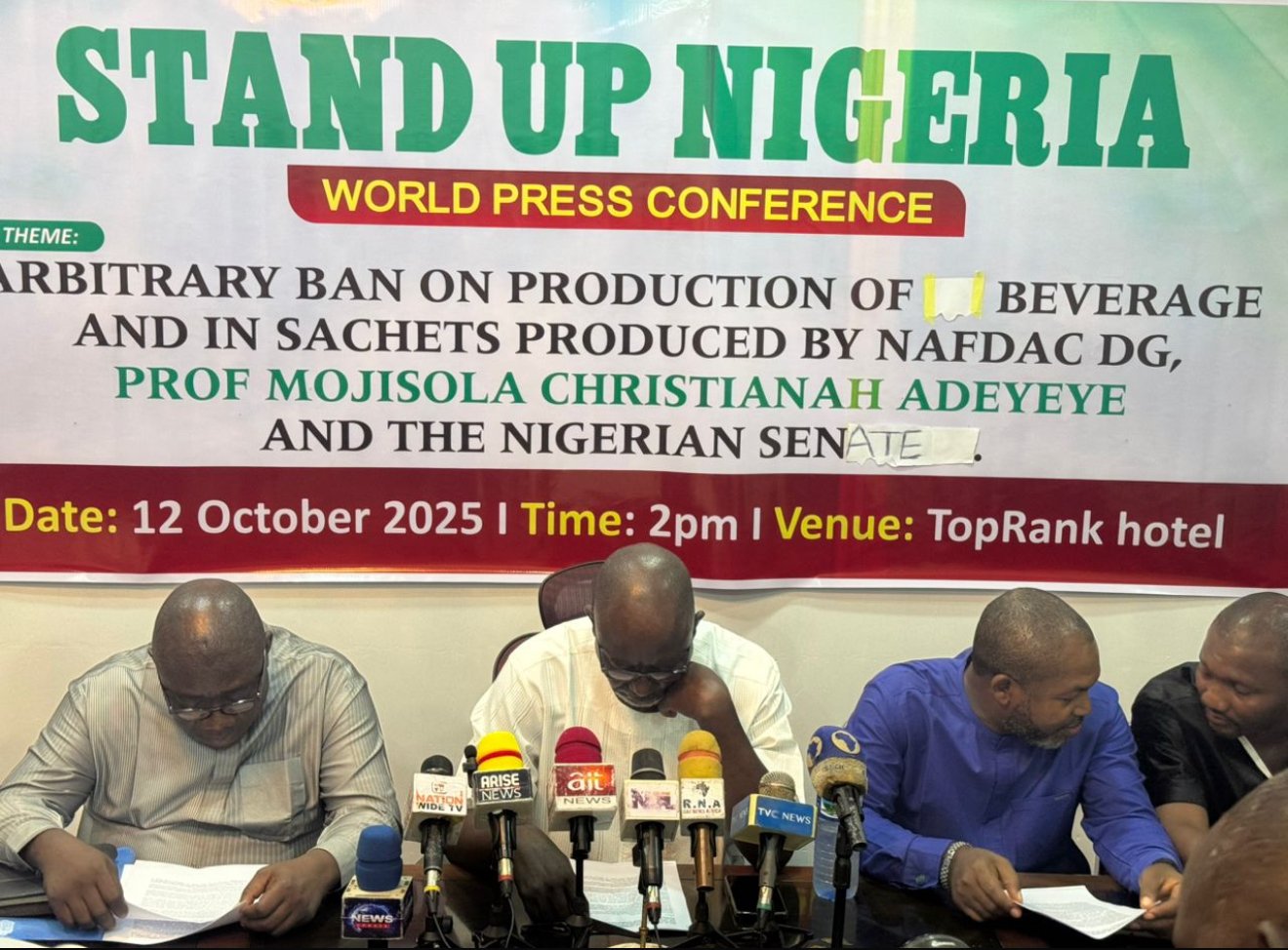
The group condemned the planned ban at a press conference on Wednesday, November 12, 2025 in Garki, Abuja.
Expressing deep concern and disappointment about the directive, the group convener, Sunday Attah, described it as high-handedness and illegalities.
The group argued that the directive contradicts President Bola Tinubu’s Renewed Hope agenda, which they said prioritises economic empowerment and the protection of local industries.
They said: “We read with rude shock that NAFDAC purportedly placed a ban on the production, distribution and consumption of alcoholic beverages in sachets and small-volume PET/glass bottles (below 200ml) by December 2025.”
The group described the anti-drug agency and Senate decision as hasty and undemocratic.
They noted that NAFDAC failed to engage critical stakeholders and industry players to reach a common ground, despite resolutions earlier adopted at a meeting with the Federal Ministry of Health and members of the House of Representatives.
“An arm of government that is ordinarily supposed to represent the interests of all Nigerians, directing NAFDAC to enforce the illegal ban on December 31, 2025, without hearing from the second party. We strongly suspect that the alleged Senate resolutions were passed at the behest of NAFDAC, at its sitting on Thursday, November 6, 2025, without taking cognisance of the ongoing consideration of the same matter by members of the House of Representatives.
They warned that if the directive were allowed to stand, it would trigger an economic dislocation of unimaginable proportions across the nation.
They added that the decision would severely affect Nigeria’s nascent economy.
These include the loss of over ₦1.9 trillion in investments by indigenous companies, the mass retrenchment of more than 500,000 direct employees, and an estimated 5 million indirect jobs tied to contractual engagements.
“Marketing and other logistics; reduction in capacity utilisation and manufacturing, which recent quarterly economic indices suggest a gradual upward movement, owing to revenues from the alcoholic industry’s contribution to the food and beverages sector; and loss of indigenous businesses that may gradually obliterate local entrepreneurship development in the economy.”
They, however, called on Ali Pate, the Minister and Coordinating Minister of Health and Social Welfare, to endorse the draft of the validated Nigeria National Alcohol Policy and its multi-sectoral implementation framework.
“That the Senate should act with dignity, fairness and respect for all in accordance with the Constitution of the Federal Republic of Nigeria that they swore to uphold, and revisit the matter by way of calling for a stakeholders’ consultation; either through public hearing or focus meetings with relevant industry players in the alcohol beverages industry, as was robustly done by the House of Representatives.