






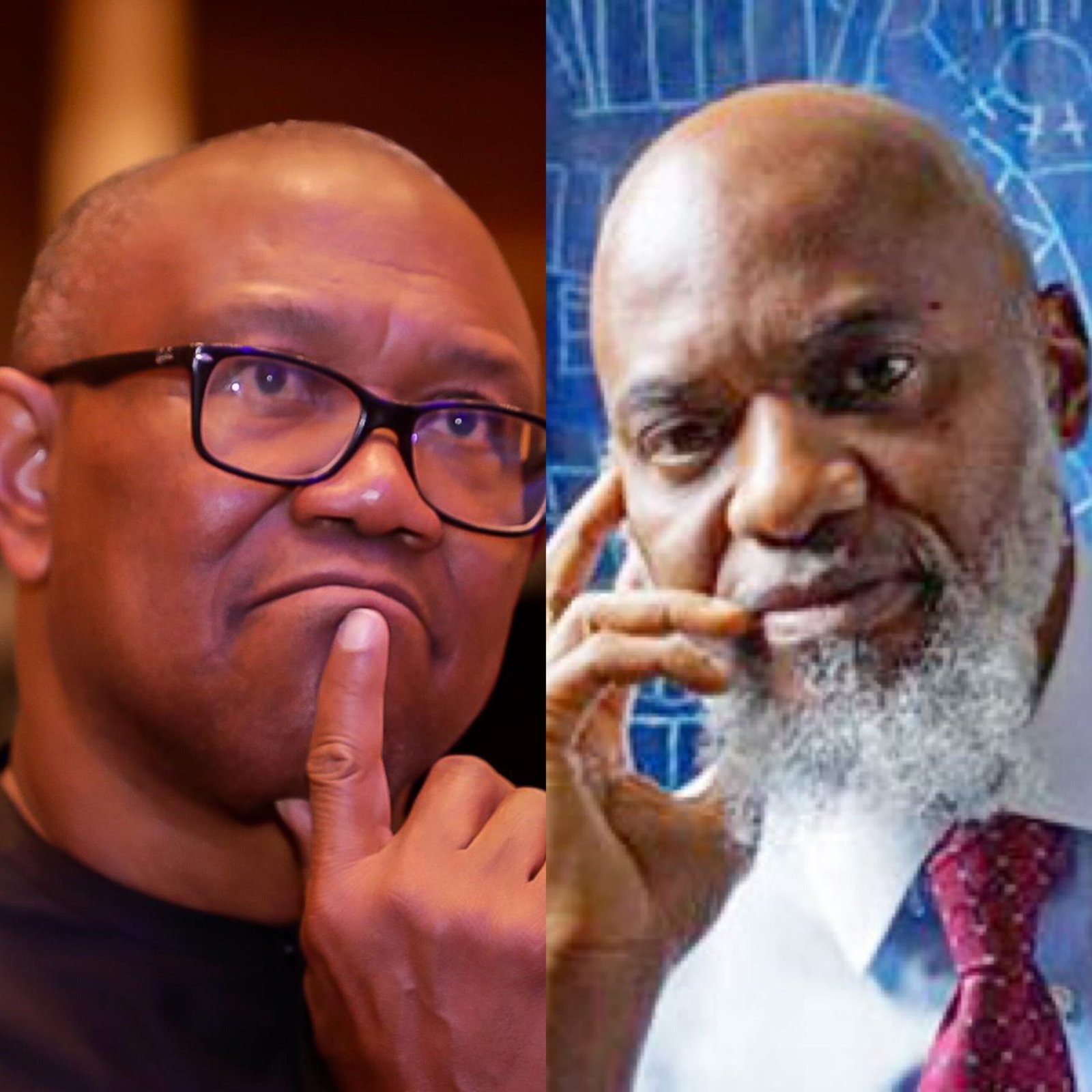
After the April 25, 2026 declined of venue for Peter Obi’s keynote lecture, the Obafemi Awolowo University(OAU), has canceled Professor Moyo Okediji lecture and book launch.
According to Okediji’s public account, Obafemi Awolowo University cancelled his lecture and book launch, and withdrew his book from the press. If that account is accurate—and OAU has a duty to tell the public, plainly and immediately, if it is not—then this is not a routine administrative adjustment. It is not prudence. It is not sensitivity. It is not crisis management. It is cowardice in academic gown.
Let us call the matter by its proper name. This is institutional surrender.
A university that cancels a lecture because people complain has not preserved peace. It has rewarded intimidation. A university that withdraws a book because some voices are uncomfortable has not protected public order. It has announced that scholarship on its campus survives only by permission of the loudest, most offended, most threatening constituency in the room. A university that cannot defend a book launch cannot credibly claim to defend knowledge. It has become a hall with classrooms, offices, titles and ceremonies, but without the moral nerve that makes a university a university.
And this is Obafemi Awolowo University, not a roadside tutorial centre. This is Great Ife, a university that officially describes itself as “the Citadel of Wisdom,” “the place of Arts and Science where men and women seek knowledge.” It is also an institution whose own mission statement says it exists to “nurture a teaching and learning community,” “advance frontiers of knowledge,” and “add value to African culture.” Those are OAU’s words, not mine. The tragedy is that in this matter, OAU appears to have behaved as if its own mission statement were decorative wallpaper.
If a university claims to advance the frontiers of knowledge, it must understand that frontiers are not picnic grounds. They are contested spaces. They are rough. They are risky. They are where the comfortable become irritated, where inherited certainties are interrogated, where pieties are dragged into daylight and asked to defend themselves. A frontier that offends no one is not a frontier. It is a brochure.
Professor Okediji is not an intellectual lightweight seeking cheap publicity. His own professional profile identifies him as a Professor of Art and Art History at the University of Texas at Austin, a writer, artist, curator, and founder/director of the Akodi Orisa Art Sanctuary in Ile-Ife. He also states that he spent more than ten years as curator of African and Oceanic arts at the Denver Art Museum and has taught at several American institutions. Whether one agrees with him or not, whether one finds his interpretations provocative or excessive, he is exactly the kind of scholar a serious university should know how to host: accomplished, rooted in the subject, intellectually visible, and connected to the very cultural worlds OAU claims to value.
That is why this cancellation is so disgraceful. If OAU cannot host Moyo Okediji on African art, Yoruba thought, cultural history, aesthetics, religion, myth, memory or whatever subject his book addresses, then what exactly is the university prepared to host? Committee meetings? Convocation speeches? Safe seminars on topics already embalmed by consensus? Shall the university now restrict itself to ceremonial scholarship—scholarship that arrives deodorised, defanged and approved by the guardians of public anxiety?
Let us be clear. A university is not a shrine to comfort. It is not a chapel of consensus. It is not a daycare centre for fragile egos. It is not a public-relations department for tradition. It is a community of teachers and scholars. The word “university” is historically linked to the Latin universitas magistrorum et scholarium, a community or corporation of masters and students. The associated idea is not timid obedience but collective inquiry. A university is a guild of disciplined argument. It is where ideas are tested, not strangled in the cradle because someone has written letters, made phone calls or threatened embarrassment.
The related word “education” is traced to Latin roots such as educare, to bring up or train, and educere, to lead out or draw forth. That distinction matters. Education is not the art of keeping people inside inherited darkness. It is the discipline of leading minds out—out of fear, out of superstition, out of lazy certainty, out of intellectual infancy. A university that cancels inquiry because of pressure does not lead anyone out. It locks the door and calls the darkness “security.”
OAU reportedly justified the cancellation on the ground that it could not “adequately guarantee the safety and security” of participants. That phrase deserves examination because it is the oldest sentence in the coward’s handbook. It is the bureaucratic equivalent of washing one’s hands in public. It sounds responsible. It sounds sober. It sounds administrative. But beneath the polished language lies a rotten principle: if people threaten disorder, cancel the scholar.
That is not security management. That is capitulation.
If there were credible threats, the university should say so with precision. Who threatened whom? What was the nature of the threat? Was it physical violence? Campus disruption? Litigation? Religious protest? Student unrest? External pressure? Internal sabotage? Was the police contacted? Was university security briefed? Was a risk assessment conducted? Were alternative venues considered? Was the event moved online? Were discussants added? Were critics invited? Was there a plan to separate peaceful protest from unlawful disruption?
If the answer to these questions is no, then OAU did not manage a security crisis. It manufactured an excuse.
A book is not a bomb. A lecture is not an invasion. A launch is not an insurrection. Words on paper do not become dangerous because cowards refuse to read them in public. If a university cannot protect a room where scholars discuss a book, it should stop flattering itself as a citadel of anything. A citadel that collapses before the first shout is not a citadel. It is a painted gate.
There is a deeper institutional question, and OAU must answer it: what happened to the peer-review process?
A university press is not a gossip market. It is not a WhatsApp group. It is not an errand office for frightened administrators. It is supposed to be governed by scholarly procedure. Manuscripts are submitted. Editors review them. External readers assess them. Reports are written. Revisions are demanded. Boards approve or reject publication. A decision to publish is not supposed to be a favour to the author; it is a scholarly judgment. If Professor Okediji’s book passed peer review and was approved for publication, then withdrawing it because of external pressure is an act of censorship. If it did not pass peer review, then why was a launch being arranged in the first place? If the review process was incomplete, who authorised public presentation? If the review was complete, who overruled it? On what grounds? By what authority? With what written record?
These are not decorative questions. They go to the integrity of the university press itself.
The moment a manuscript can be withdrawn after approval because people are uncomfortable, the press ceases to be an academic press. It becomes a fear-processing unit. It no longer answers to scholars, reviewers, editors and standards. It answers to pressure. And once that precedent is established, no serious scholar is safe. Today it is Moyo Okediji. Tomorrow it will be a historian of Ife kingship. Next week it will be a sociologist of religion. Next month it will be a philosopher of gender. Soon enough, every manuscript will be written with one eye on evidence and the other on possible outrage.
That is how universities die: not always by military decree, not always by funding collapse, not always by government censorship, but by internal cowardice. They die when administrators begin to confuse quiet with order. They die when managers replace scholars. They die when reputation becomes more important than truth. They die when the fear of controversy becomes stronger than the duty to educate.
Academic freedom is not a favour granted to agreeable scholars. It is the condition under which scholarship exists. The widely cited 1940 AAUP statement on academic freedom affirms the principle that teachers are entitled to freedom in research and in the publication of results, as well as freedom in the classroom and freedom from institutional censorship when speaking as citizens. One does not have to belong to the American Japanese academy to understand the logic: research that can be silenced by administrative panic is not free research.
Of course, academic freedom is not immunity from criticism. Let no one twist the argument. If Okediji’s book is poorly argued, attack the argument. If it contains errors, identify them. If it misreads evidence, expose the misreading. If it offends religious or cultural communities, let those communities respond with reason, counter-evidence, counter-interpretation and moral argument. Publish reviews. Organise a rebuttal symposium. Invite critics. Put the author on a panel with his fiercest opponents. Let the room be hot. Let the debate be rigorous. Let the audience leave unsettled.
That is what universities are for.
But cancellation is not criticism. Withdrawal is not debate. Administrative silence is not scholarship. A banned book has not been defeated intellectually; it has been spared examination by the cowardice of those who feared what examination might reveal.
The phrase “numerous letters, phone calls, and other requests” should alarm every scholar. Since when did the volume of complaint become a standard of academic judgment? Since when did the telephone become a peer reviewer? Since when did outrage acquire editorial authority? If ten people complain, does a chapter disappear? If fifty people threaten protest, does a manuscript die? If one hundred people invoke “security,” does truth go into exile?
A university’s job is not to count complaints and obey the majority of irritation. Its job is to separate argument from intimidation. Its job is to distinguish offence from harm, criticism from censorship, protest from coercion, and discomfort from danger. If people dislike a book, they may write against it. If they find it blasphemous, they may denounce it. If they believe it is historically wrong, they may correct it. If they consider it ethically dangerous, they may say so in public. But they have no right to veto its existence, and the university has no right to lend them that veto through cowardly administration.
What makes this worse is the subject-area implication. Okediji’s work is deeply connected to African art, Yoruba culture, visual thought and the intellectual worlds that OAU ought to be uniquely prepared to debate. His public profile identifies the Akodi Orisa Art Sanctuary in Ile-Ife as part of his work; OAU itself states that part of its mission is to add value to African culture. If a university sitting in Ile-Ife cannot host difficult conversations on Yoruba culture, spirituality, art, memory and meaning, then where exactly should those conversations occur? In London? Austin? Berlin? New York? Shall Yoruba civilization be discussed everywhere except the Yoruba intellectual landscape that claims to inherit it?
There is something almost comic in the tragedy. An institution named after Obafemi Awolowo, one of the most intellectually forceful and controversial political figures in modern Nigerian history, now appears frightened by a book launch. Awolowo built his public life on argument. He provoked. He challenged. He divided opinion. He generated fierce loyalty and fierce opposition. He understood that ideas shape societies. An institution bearing his name should not behave like a nervous clerk hiding under a desk because someone raised a voice in the corridor.
OAU’s official foundation page states that the university was founded in 1962 as the University of Ife and renamed Obafemi Awolowo University in 1987 in honour of Awolowo. It also calls Great Ife “the Citadel of Wisdom.” That phrase now stands as an accusation. Wisdom does not cancel books because of pressure. Wisdom does not retreat from inquiry. Wisdom does not confuse safety with silence. Wisdom does not outsource judgment to rumour.
The security argument is particularly insulting because universities routinely handle controversial events. They manage protests. They provide marshals. They restrict entry. They require registration. They place critics and speakers in structured debate. They use security personnel. They coordinate with law enforcement. They change venues. They move events online. They issue codes of conduct. They warn against violence. They protect the speaker and the audience while preserving the event. Cancellation may sometimes be necessary in the face of imminent, credible, uncontrollable danger—but it should be the last resort, not the first instinct.
If OAU had credible intelligence that violence was imminent and unavoidable, it should say so. If not, the “security” justification is merely a fig leaf covering institutional nakedness.
And let us speak plainly about administrative cowardice. Nigerian universities have become too skilled at the politics of avoidance. They avoid religious controversy. They avoid ethnic controversy. They avoid political controversy. They avoid alumni controversy. They avoid donor controversy. They avoid student controversy. They avoid anything that might require a vice-chancellor, dean or press board to stand upright and say: “This university does not endorse every idea it hosts, but it will defend the right of ideas to be heard, examined and challenged.”
That sentence should not be difficult. But in too many places, it has become revolutionary.
The modern Nigerian university is increasingly managed as if its highest calling is not truth but peacekeeping. Not peace as justice. Not peace as reasoned coexistence. Peace as quiet. Peace as the absence of embarrassment. Peace as the successful burial of inconvenient matters before they reach the newspaper. Peace as the suppression of anything that might make administrators sweat.
But a university built on that definition of peace is not peaceful. It is intellectually dead.
Real peace in a university comes from confidence in process. If a book is bad, review it. If a claim is false, refute it. If a speaker is controversial, contextualise him. If audiences are angry, moderate the discussion. If protesters assemble, protect their right to protest peacefully while denying them the power to silence. If threats are made, arrest or discipline those who make them. That is institutional maturity. That is leadership. That is how a university behaves when it remembers what it is.
By contrast, cancellation teaches the wrong lesson to everyone. It teaches pressure groups that they can win by threatening disorder. It teaches scholars that difficult work is professionally dangerous. It teaches students that the answer to discomfort is suppression. It teaches administrators that cowardice is easier than principle. It teaches the public that universities no longer trust their own methods.
This is how intellectual life is reduced to mob management.
OAU must not be allowed to hide behind vague language. It must produce the decision trail. Who cancelled the lecture? Who withdrew the book? Was the vice-chancellor involved? Was the university press board consulted? Were external reviewers’ reports overturned? Did the faculty or department that invited Okediji agree with the cancellation? Was there a security report? Was the author given a written explanation? Was he offered an alternative date, venue or format? Were the complainants asked to submit scholarly objections? Were threats reported to police? Were those who threatened violence identified?
A university that makes a decision of this gravity owes the public more than administrative fog.
And if OAU cannot answer these questions, then the academic community should draw the obvious conclusion: the cancellation was not the result of process but panic.
What should OAU do now? The path is simple, though it requires a courage that is apparently in short supply.
First, reinstate the lecture and book launch, whether physically or through a controlled hybrid format with proper security. Second, return the manuscript to the press process immediately. If the book has passed peer review, publish it. If it has not, submit it to independent reviewers and let scholarship decide. Third, release a public explanation of what happened, including the procedural basis for the cancellation and withdrawal. Fourth, invite critics of the book to produce written responses and participate in a formal symposium. Fifth, apologise to Professor Okediji if the university acted without scholarly grounds. Sixth, establish a clear academic-freedom protocol so that future administrators cannot strangle inquiry whenever pressure rises.
That is the minimum. Not heroism. The minimum.
Those offended by Okediji’s work should also be told the truth: offence is not an argument. Indignation is not evidence. Cultural anxiety is not scholarship. If you believe the book is wrong, read it and demolish it. If you believe it misrepresents Yoruba culture, marshal Yoruba sources and expose its weaknesses. If you believe it is spiritually offensive, explain why in a public forum. But do not demand silence and call it defence of tradition. A tradition too fragile to survive a book launch has already become museum glass.
The university, likewise, must remember that African culture is not preserved by intellectual timidity. Culture is not a corpse to be guarded from questions. It is a living field of argument, reinvention, memory and dispute. Yoruba culture has survived empire, Christianity, Islam, colonial anthropology, missionary distortion, nationalist romanticism, academic theory, diaspora reinterpretation and modern artistic experimentation. It will not be destroyed by Moyo Okediji’s book. What may be destroyed, however, is OAU’s credibility if it proves incapable of hosting a serious conversation about it.
The bitter irony is that cancellation will likely give the book more attention than the launch ever could have done. Suppression is poor strategy. It advertises what it tries to bury. It turns a scholarly event into a scandal. It transforms a manuscript into forbidden fruit. It invites the public to wonder what the university is so desperate to hide. If OAU hoped to avoid controversy, it has achieved the opposite. It has converted controversy into indictment.
And the indictment is severe.
A university that fears a book has lost intellectual muscle. A university that rewards complainants before hearing arguments has abandoned judgment. A university that allows security language to become a mask for censorship has betrayed its students. A university that withdraws a manuscript without transparent scholarly grounds has insulted its press, its reviewers, its faculty and its name.
This is not how a citadel behaves. This is how a frightened bureaucracy behaves.
OAU should reverse itself. Immediately. Publicly. Without the usual Nigerian administrative dance of committees, clarifications, denials and face-saving evasions. Restore the event. Restore the book. Publish the reasons. Invite the critics. Defend the process. Let the debate happen.
If Professor Okediji is wrong, let him be defeated in argument.
If his book is weak, let reviewers expose it.
If his claims are provocative, let the provocation produce thought.
But do not cancel him and pretend that silence is wisdom.
That is not wisdom. It is not learning. It is not culture. It is not safety. It is institutional cowardice dressed in administrative grammar.
A university does not prove its greatness by avoiding difficult ideas. It proves its greatness by surviving them, testing them, correcting them, and teaching its students how to think in their presence.
If OAU cannot do that, then it should retire the phrase “Citadel of Wisdom” until further notice.
A citadel that cannot defend a book is not a citadel.
It is a temple of silence.